摘要
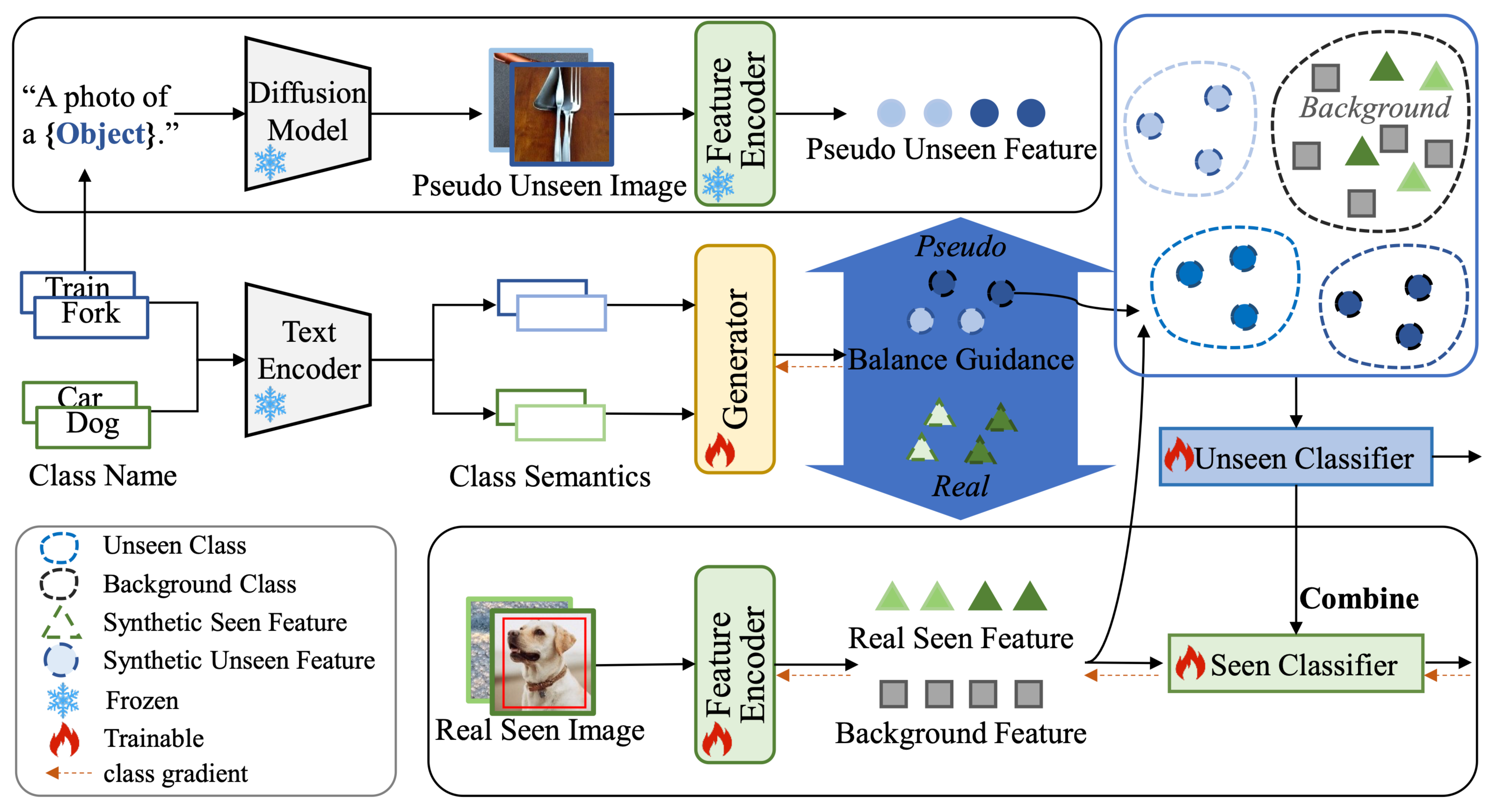
The goal of zero-shot object detection (ZSD) is to localize and classify objects that haven’t been presented in the training set. Drawing inspiration from the success of generative models, many feature generation based approaches have been explored for the ZSD problem, which had some promising results. However, the absence of visual samples from unseen classes inevitably leads to subpar synthesized features, thereby constraining the generator’s efficacy in prior approaches. This limitation highlights a key challenge in current ZSD methods: generating discriminative and realistic visual features without real data support. To address this, our method is motivated by the insight that semantic embeddings alone are insufficient for generating high-quality features. Instead, we align them with pseudo-visual features extracted from a diffusion model, which provides more visually plausible guidance and significantly improves the quality of synthesized features for unseen categories. Additionally, unlike previous works, the real visual features of seen classes is also used to train the unseen classifier, which is considered as the background class. Such a trained unseen classifier has less chance to misclassify a seen object into an unseen category. While working with the pretrained seen classifier, it performs better in the real world application, i.e. the generalized ZSD situation. Extensive experiments on MS COCO and PASCAL VOC demonstrate that our method achieves state-of-the-art performance.