 Illustration
摘要
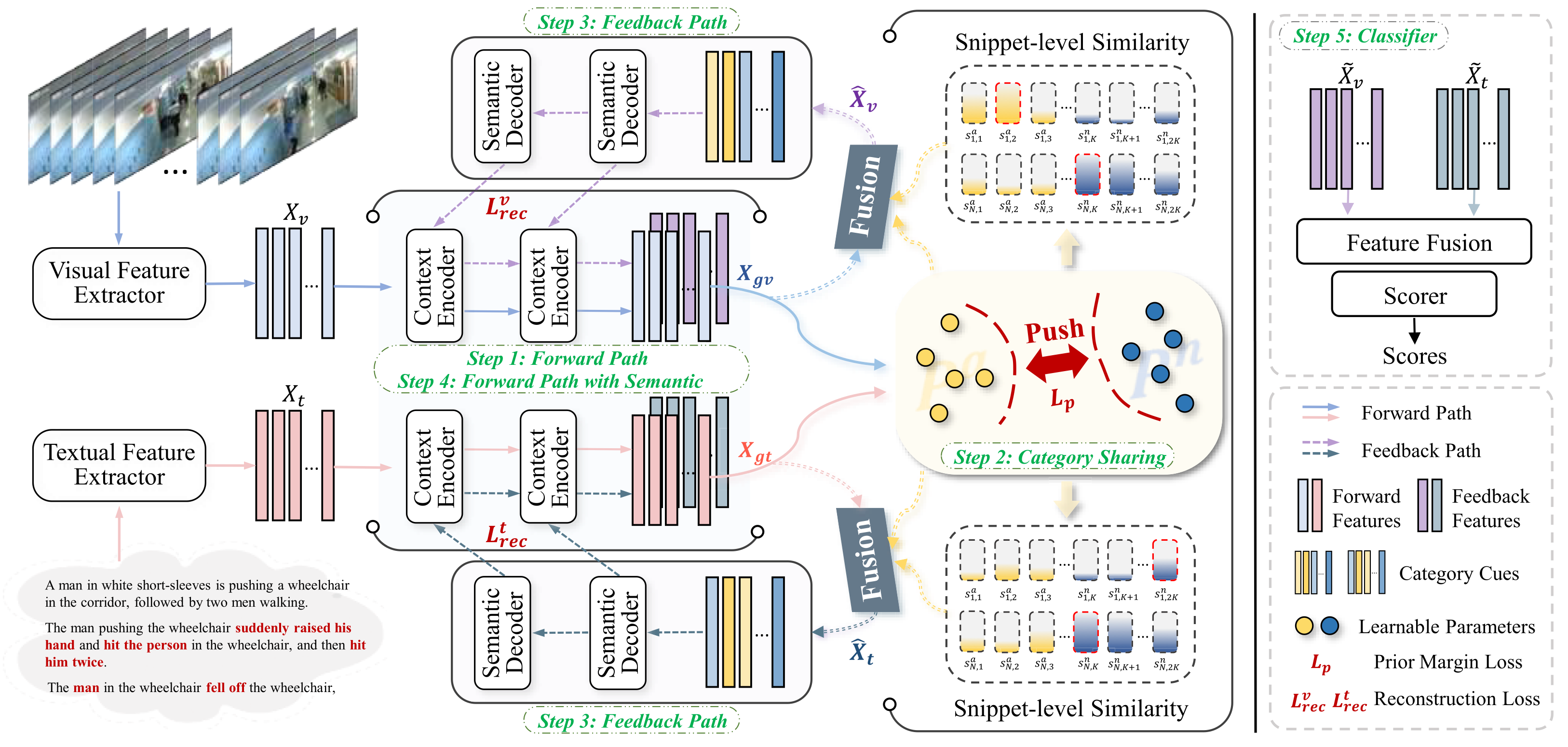
Vision-language models have the potential to enrich purely visual tasks by utilizing the combined representation of images/videos and corresponding textual descriptions. Recent advances in video anomaly detection have also integrated textual information to enhance the understanding of abnormal events. However, existing approaches often merge visual and textual modalities in a straightforward, bottom-up manner, failing to fully explore their interconnections. Moreover, textual captions themselves do not inherently convey “abnormal” attributes. Consequently, these joint representations tend to highlight all salient input features without adequately focusing on high-level tasks such as video anomaly detection. To direct the model’s attention towards anomalies more effectively, we propose incorporating a top-down mechanism into weakly supervised video anomaly detection tasks. A new Knowledge Sharing and Feedback (KSF) framework is designed to unify the representation of anomalies across both video and text. Specifically, we develop a category pattern sharing module that performs knowledge matching, acting as an alignment bridge between abnormal events and their corresponding descriptions. This ensures consistent representations for identical anomalies while maintaining distinct representations for different ones. Following this alignment process, matched high-level semantic priors are fed back into the forward path to enhance differentiation between abnormal and normal patterns. Comprehensive experiments on three benchmark datasets demonstrate the superiority of our proposed method in learning the implicit definition of anomaly patterns. The code is available at https://github.com/XJ-Cai/KSF